brands-do your research now!

inspect Adapt or die. Never has this statement been more true. Consumer brands are dealing with an overnight change in attitudes and values that is unprecedented in modern consumerism. From travel to jeans to soap to museums – no product or service or experience will survive this tumultuous period without re-examining their value proposition and the role they play in their consumer’s life.

Between the economic crisis lead by Wall Street and AIG, the environmental crisis and now adding insult to injury – the AIG bonus payout – consumers are retreating and rethinking every single dollar that leaves their pocket and who it will go to. In fact, the Edelman Trust Barometer reports that U.S. consumer confidence is even lower than it was after the dot.com bust and the Enron scandal. Things aren’t much better internationally, 62% of respondents across 20 countries included in this same survey report less trust in business than a year ago.

The result is that the brand relationship with consumers is about to get very interesting. Current brand equity will still play a critical role in consumer decisions but each and every brand needs to get out there and understand what their new consumer needs are a.s.a.p. There are a plethora of marketing reports coming out on issues of sustainability, moderation behaviors and other factors that will play a role in future consumerism. These reports are valuable but are simply the backdrop for independent research that should be done to understand these trend drivers first hand as they relate to a company’s brand. This shift doesn’t mean that brands need to lose or even change their core brand assets. They simply need to look for new ways to relate and to re-look at how their products communicate with their current audiences and their new behaviors.

For example, the New York Times reported last week that museums across the country are now opening their doors to entirely new audience segments via discounted special events that build on their core offerings. In San Francisco, the Academy of Sciences has debuted Nightlife – a weekly evening event incorporating DJ’s and special science activities that brings together a much different crowd than the kids, parents, tourists and science geeks the Academy usually attracts. Not only are they finding new hours to open their doors but they are attracting new audiences that have traditionally dismissed this type of cultural institution en masse.

It’s this type of re-invention and exploratory relationship building that needs to take place across the spectrum. Simply speaking to green or pricing trends via advertising or promotion will ultimately miss the opportunity to play an important and trusted role throughout the upcoming years of significant value and lifestyle restructuring.

really?

tds_logo

Rarely do I write about politics – that’s not what this space is for.  But I feel compelled to write and – ask for feedback  – on last Thursday night’s Daily Show.  Jon Stewart is pretty much my idol.  He’s one of those “who would you invite to dinner if you could” guys.  Even when he gets totally over-the-top angry (as he certainly did in the months leading up to the election), he’s a provocative truth-telling genius.

But I sat in total disbelief as Jim Cramer sat there and let himself (his brand) be totally annihilated last Thursday.  How, why would Jim do this?  He’s a media celebrity – they don’t set themselves up for feature length (as comedy sketches go) spectacles of mockery.

The only explanation that I’ve been able to come up with is that this was a PR strategy employed by CNBC to pave a path for restoring their own reputation.  “Encouraging” Jim to go on last week’s media tour and concluding it with the “showdown” on The Daily Show had to be the result of some serious backroom talks.

Which kinda bums me out….wouldn’t Jon have told us if this was how/why Thursday night’s show came to be?

You can see the full unedited 21 minute version of the interview on the Daily Show web site and also read some of the discussion around the event on the Huffington Post.

drinking for good

snuggiepubcrawl-chicago2

It’s small. It’s grassroots, but this is how you build good-will AND a brand name.  Think Red Bull.

The Snuggie Pub Crawl Team is promoting the AC-Orphanage in Arusha, Tanzania on FaceBook but one wonders if there might be an opportunity to increase their fund-raising impact if FB and Global Giving (an online giving portal) were synced up.

Regardless, this is an awesome idea….and even though its not THAT cold here in Northern California, dressing up in anything has all the markings of an event made for SF.   Snuggie Bay-to-Breakers team, anyone?  Oh, and you can email the Snuggie team at the email above to request an event in your own city.

Hat tip to David at Marketing + Good for this one.

the carbon authority: part one

carbon-neutralIn a swath of green fury, there is a whole new market emerging which most consumers have heard of but for the most part, have no clue if it will ever become relevant to their daily lives.   To some degree none of us know what role our march toward a carbon neutral economy will play in our not-too-distant future yet there are signals locally and globally that the carbon market may ultimately play a significant role in our daily choices.  The question is  – who will guide us in the adoption of practices that will truly help us understand this market.

To a certain degree, it is probably too early to ask this question.  The early days of the mobile phone industry were governed by industry wide regulation, distribution and demand.  Demand drove consumers to purchase despite mass confusion over cost protocol and brand authorities didn’t emerge until the market had stabilized and penetrated the most sought after consumer – the teen.  It took us over a decade to begin to feel like we understood how to evaluate “Rollover minutes” against “Nights and Weekends Free” against “myFaves” (although one could argue we still don’t know why we’re locked into two year contracts).

So, it’s likely that we are ten even twenty years before we truly begin to understand what the outcomes of all the debate in Washington and abroad is about as it relates to understanding our role in neutralizing the carbon in our atmosphere.  This is an operational challenge that will be driven by regulation not demand.   Yet there seems to be market activity that signals this evasive concept-commodity could and actually is being productized at a mass consumer level.

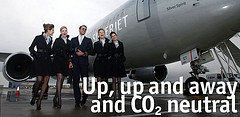
Many airlines now offer individuals the opportunity to purchase carbon offsets at the point of their ticket purchase and online calculators such as Terrapass provide individuals and businesses the opportunity to purchase carbon credits to offset their output.  Termed “offsets” these credits are the product of a  financial mechanism created to regulate carbon output and including organizations naturally protecting sequestered carbon.  Most of us have begun to hear the term “offset” but will readily admit we have no idea what it really means, let alone starting to dig deeper to know what “standard” the carbon has been verified against to determine its true value.

The interesting question is,  who will emerge to be the (brand) authority in this new market?  What business and in what tier of the consumer eco-system will emerge to establish credibility and drive the standard to which we will make our assessments? And what industry can we look to previously that might shed some light on where this new market might be going?

floating garbage

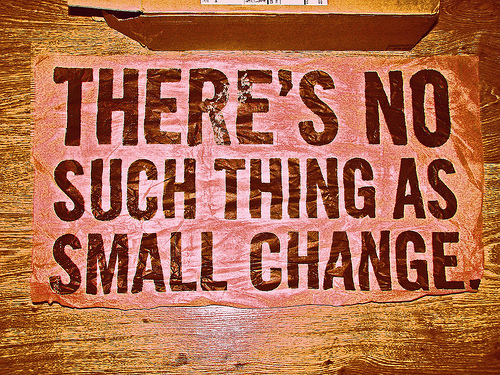
ba-plastiki03_ph_0499860243A sailboat made of recycled plastic?  The Plastiki is the brainchild of David de Rothschild, a polar adventurer and scion to the Rothschild family heir.    It  is a 60 foot catamaran that is potentially an innovative wonder made of recycled plastic bottles and materials crafted from self-reinforced PET.   Intended for completion and launch “sometime next month” (or maybe next), the Plastiki is currently undergoing its build off Pier 31 in San Francisco.  The intent is to raise awareness for his foundation Adventure Ecology and the work it does via a sail from the U.S. to Australia which will take it through the little-known Great Pacific Garbage Patch.
Sounds like an amazing endeavor with the potential to draw much-needed attention for the harm plastic garbage thrown into our oceans causes.  Yet, this journey has all the markings of a Richard Branson stunt, minus the “credibility” – which firmly moves back all those strides  greenies have been making in getting the green movement out of hippieville.

I am actually a big fan of Richard Branson, but it takes more than money to draw credible, actionable attention.  I absolutely “heart” David for his intentions, but I’d like to take this opportunity to propose a bit of context for his next well-intentioned and ambitious adventure:  1) develop a solid plan that meets the approval of experienced engineers – self-mockery on the liklihood that it will contribute to the aqua-junk doesn’t help focus attention on the cause of waste as resource. 2) establish credible partnerships that can help you spread the word –  companies (like P&G or Nestle) that buy into your strategy and can promote your success will actually create impact where the problem starts – at the corporate and consumer level.  3) Which goes to say that self-depracating humor is infinitely enjoyable, but avoid the trappings of a “stunt”.    The best story (and video) I read on David was found on a National Geographic Adventure blog dedicated to the Plastiki because it included lots of facts and established some solid grounding for the whole concept. Still the humor of the “we might not make it” (in the video) will only work for the cause – if truly, he makes it. (and I hope he does!)

100 Change-Makers

change-listI came across a blog recently that I hope to see replicated one day by Fast Company, Good, or another change-inspiring publication.  Instead of the Fortune 500, Forbes 100 or even BusinessWeek’s 100 Best Global Brands (thank you Interbrand), Duke Stump of The Northstar Manifesto has created The Real 100.  This list is created of companies and individuals “defined by their ability to spark a revolution of new thought and possibility.”  This list is truly a personal one (I love the fact that Eddy Vedder is on it!), but it covers rich territory.   From B Corporation, to Better Place to Van Jones to Paul Hawken – it addresses thinkers and companies committed to implementing real structural change.

To the next publishers of this list, I would submit that Duke’s list (self-admittedly) leaves out some major players who I hope to see added to the glorified, branded, newly-titled 100 Change-Makers list:

1) The Bill & Melinda Gates Foundation.  With a $U.S. 35.1 billion dollar endowment, the scale of this foundation’s giving and thinking is fueling major reform in global health, education, poverty reduction and access to technology to spark a revolution in philanthrocapitalism.

2) The Global Fund to Fight AIDS, Malaria and Tuberculosis. Conceived as a public-private partnership financing programs to end these three diseases, it has committed $U.S. 11.4 billion to 550 programs in 136 countries.   As a financier, its role cannot be underestimated in bringing government, science, companies, the health community and its partner organizations together in a collaborative effort to effect the end of these diseases as we know them.

3) Global Giving.  Much has been credited to the for-profit micro-finance efforts of Kiva.  It definitely belongs on the Change-Makers list.  But so does Global Giving.  With a division set up to advise companies on their employee giving, GG is set up to strategically integrate a turn-key giving portal aligned with a well-suited non-profit endeavor that speaks to companies’ cultural ethics and values.  The much bally-hoo’d Wal*Mart PSP set the stage for this endeavor but Global Giving is the mechanism  to mass deliver increased CSR at the employee level.

4) (RED).  Many will disagree with me here.  (RED) has suffered and struggled.  But (RED) was the first brand to attempt to merge the world of consumerism and social responsibility.  It has suffered the way many pioneering concepts do.   But, it was the first model of its kind and it deserves credit for the revenue its generated on behalf of AIDS (US$ 120 million so far).  (RED) has hit some bumps in the road but I’m looking forward to its next steps.

partnering for our urban good

nyc-transportation-alternativesPSFK reported last week on NYC’s Transportation Alternatives program Nine for ’09.   NYCTA been around since 1973 and they’ve done some tremendous advocacy work in the areas of bicycling , walking and taking public transportation to reclaim New York’s streets from the automobile. They have already announced their September NYC Century Bike Tour and clearly they’ve got some talented design folks on their side.

The question I have is why haven’t they enlisted corporate support? Nike Considered Products, Trek bicycles, Timbukt2 bags would be perfect “urban” supporters –  to name a very few. All of these could develop some pretty cool high-profile retail promotional programs around what are already some really well-thought out events.

With a population’s increasing attention on what’s happening locally, for the city by the city, companies would do well to give-back in a way that  parallels what our overstretched and under-funded gov’t is attempting to do.    Tapping existing, smartly run and well-marketed programs is just the way to do that.

25 things…an innovation tool

25-thingsHow many articles have you read about “leveraging social media”  yet how much real implementation have you seen?  Researchers, companies pay attention.  Memes provide very specific opportunities to participate in social media phenomena.   And The 25 Random Things about [insert your product or service here] sweeping FaceBook – among others – is a no brainer to both implement and learn from.
People love to talk about themselves.  They also love to talk about the things they love (and hate for that matter).   Using FB or Ning or any other social network to initiate research on your product using this format has tremendous potential because it: 1) requires a long list…this means patterns will emerge; 2) it also means that people will be forced to think beyond the top well-published “issues”, they’ll be forced to think about the emotions and situations which cause them to love or hate – this leads to real usable insightful information;   and 3) besides yet another reason to publish a personal opinion, who doesn’t love participating in the trendiest thing out there?

Now, 25 Random Things about Me…….

iPhone as fundraiser

iphone1Is there anything the iPhone can’t do?

Shazam figures out what song you’re listening to.  A pocket flashlight (not to mention a light saber) is only two taps away.  And Yelp can get the phone number, directions and even a review of the place you’re trying to find and meet your friends at in a quarter of the time directory assistance, Safari, Google or any mapping software can do it.

So, why wouldn’t our love affair with the iPhone help us make the world a better place?  Why wouldn’t our obsessive usage create perfect opportunities for capturing micro-donation portals to make contributions to the micro-finance or giving sites of Kiva or Global Giving?  What about a carbon calculator that lets you immediately link to an offset purchase equivalent to the inquiry? It would seem that millions of tiny donations could add up to lots of impact.    It seems possible, and even more so fun.  But does it really add up to a smart fundraising play?

Part of what makes the iPhone so magnetic (and what Apple is famous for) is the sheer simplicity, intuitiveness and delight you experience when you begin interfacing with each of the singular functions that each application features.  Mostly they are personal devices for entertainment or utility.  They draw you to your phone because you either need the info or you need a time killer.  The apps are sexy brilliant in their use of the technology and the format.  Every time we download a new app, we are sucked in, at least for a short time period.

The challenge for social ventures to monetize applications will be to determine if there is a big enough audience at the intersection of 1) organization loyalists and 2) iPhone enthusiasts.   This will require some thoughtful creativity and long-term dedication on behalf of the organization.  Which is to say that creating an iPhone app alone is only one piece of the equation –  how each app gets marketed and updated will be critical to its effectiveness.
Continue reading

leveraging MLK day

target_oprah_static_184x901Very rarely do big brands get it right when inserting themselves into historic moments in time.  The SuperBowl ads have become an event within an event but we’re ok with that because the entire event is about pure unadulterated exploitation for entertainment.    The  Olympics have sold their soul and we’ve come to accept it.   Brands who pay the global big bucks are simply spending our money to be able to get our money.   We all know its part of the game.

But it takes the right kind of brand to  dare touch a nation that is in a delicate stage of heightened optimism – driven mostly from an eight year period of feeling duped – and actually do it with class and inspiration.  By building on its authentic efforts already commited to the communities it serves, Target has managed to do just that on  MLK day.    By tying into the historic inauguration of our first black President, his proclamation towards a day of community service, and by leveraging Oprah’s star-studded homage to this two day time, Target has brilliantly connected to their audience and promoted the message of community service that lives within what this day is all about.  To say that their vision is altruistic would be foolish.  But if all brands could use their name to drive home messages of helping others – just imagine.  “I have a dream”